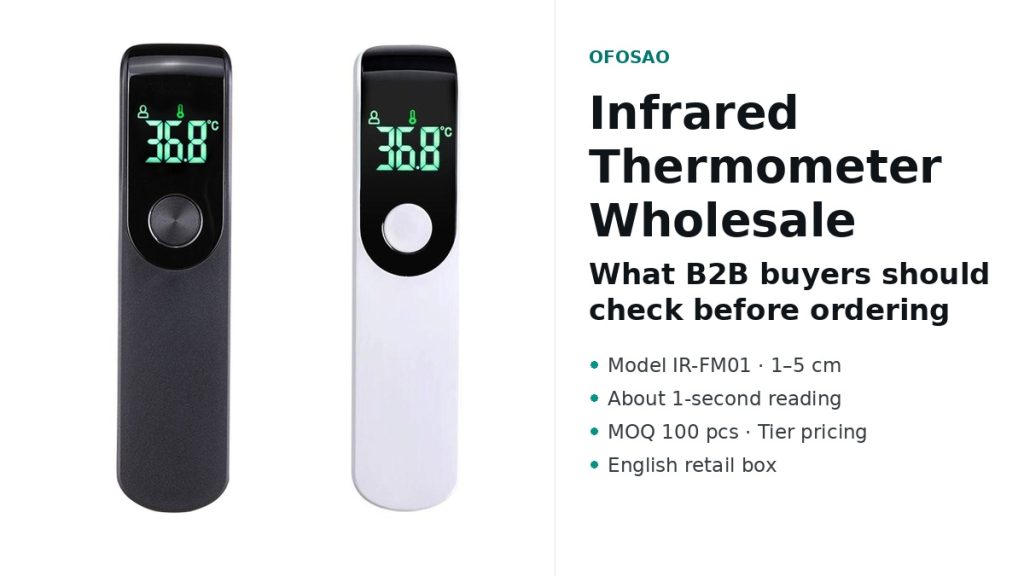
Infrared thermometer wholesale is no longer only a pharmacy category. Distributors, clinic suppliers, workplace health programs, airport screening stations and travel-retail buyers are all sourcing compact non-contact thermometers as a low-weight, shelf-ready SKU. The problem is that two suppliers can quote the same “mini infrared thermometer” at very different prices, and the difference is usually hidden in the specification sheet, the carton data or the documentation package.
This guide uses the OFOSAO mini infrared forehead thermometer (model IR-FM01) as a practical example. It explains what to compare before you place a wholesale order, how MOQ and tier pricing work, and which questions to send a supplier before you pay a deposit.
Why mini infrared thermometers fit B2B assortments
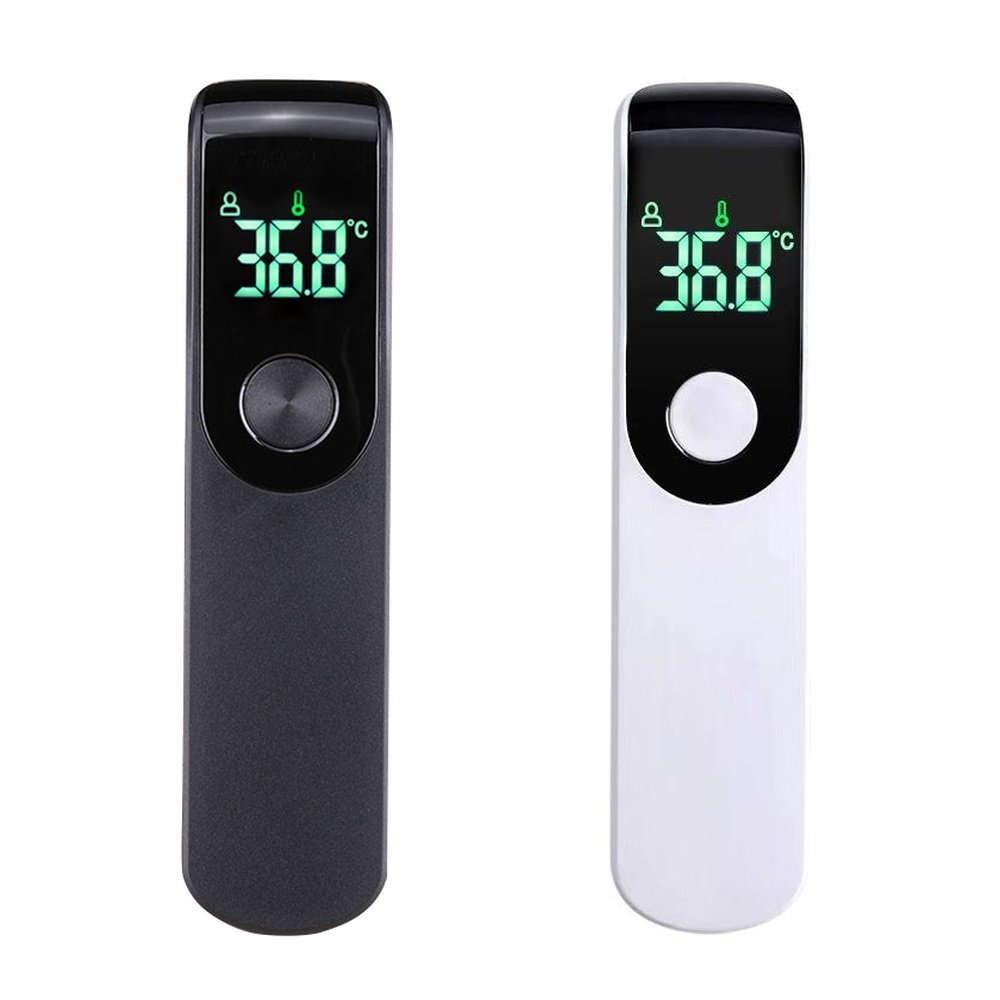
A mini forehead thermometer is small, light and simple to operate. It does not need a probe cover, it does not touch the forehead, and it can switch between body and object modes. For a distributor, those features make it easier to place in a pharmacy counter, a clinic front desk, a workplace first-aid station or a travel-retail display.
The compact format also changes the freight equation. A device that weighs about 35 g and ships 100 pieces to a carton is cheaper to move than a bulkier thermometer, especially when the order is air-freighted. That is why carton dimensions and gross weight belong in the same comparison table as the unit price.
The specs that change the quote
When you compare infrared thermometer suppliers, start with the measurement basics. For the IR-FM01, the supplier states a 1–5 cm measuring distance, a response time of about one second, a 32.0–42.9°C range, 0.1°C resolution and an operating environment of 16–35°C at ≤85% RH. Those numbers affect how the device is used and how it should be described in your market.
A 1–5 cm distance is short. It means the user holds the unit close to the forehead instead of scanning from across a room. That can be an advantage in a controlled indoor setting, but it also means your packaging and instructions must explain the correct distance clearly. If a supplier quotes a longer distance without changing the optics, ask for the test method behind the claim.
Response time is another comparison point. “One second” is a marketing-friendly number, but buyers should confirm whether it is the time from pressing the button to a stable display, or the time for a single sample. Ask for a short video or a live sample test rather than relying on the listing title.
Body and object modes are useful for distributors because one SKU can cover two use cases: forehead temperature screening and surface temperature checks. The mode switch should be easy to explain in the manual, and the display should make the active mode obvious. If the mode is buried in a long press sequence, it will create support tickets at retail.
Power is a practical B2B issue. The IR-FM01 uses two AAA batteries (DC 3.0V). Confirm whether batteries are included, because alkaline cells can add weight, create transport restrictions in some channels and complicate retail-ready packaging. If batteries are not included, say so on the box or in the listing so the end user is not surprised.
Finally, check the physical data: 122 × 29 × 23 mm and about 35 g net weight. These numbers look minor, but they determine how many units fit a carton, how much padding is needed and what the freight quote will be.
MOQ and tier pricing: how to read a wholesale quote
A low headline price is not useful if the MOQ does not fit your channel. For this product, the MOQ is 100 pieces, with three published tiers: 100–999 pieces at $2.00 per piece, 1,000–2,999 pieces at $1.70 and 3,000+ pieces at $1.50. All prices are in USD per piece; freight, duties and taxes are quoted separately.
At the first tier, 100 pieces is a $200 product order. That is a realistic starting point for a distributor test, a clinic group or a small private-label run. At 1,000 pieces, the product value is $1,700; at 3,000 pieces, it is $4,500. The step-down is meaningful, but it only works if you can move the volume without tying up cash.
Build a simple landed-cost sheet before you choose a tier. Add the unit price, the freight quote, insurance, duties, destination handling and any labeling or packaging change. Then divide by the number of sellable units, not the number of units you ordered. If 5% of the carton is damaged or held for replacement, your real unit cost is higher than the quote.
Freight should be quoted on weight and volume, not on a flat per-order guess. The carton data for this SKU is 100 pieces, 332 × 265 × 138 mm and about 4.4 kg gross weight. Use that to ask for a door-to-door or port-to-door quote. For a 100-piece order to Los Angeles, the site’s current volumetric rule calculates about $50 in shipping; that is an illustrative number, not a fixed worldwide rate.
Compliance and documentation checklist
Infrared thermometers sit in a regulated space in many markets. The supplier states that this model has Chinese medical device registration and can provide supporting documents. That is not the same as CE, FDA or UKCA approval, and it is not a guarantee that the product can be sold in your destination without local registration.
Before you order, ask for the documents that apply to your channel: registration or notification documents, the instruction manual, the label artwork, the model and manufacturer name, the battery specification and any test reports the supplier can share. If you are selling on a marketplace, check the marketplace’s medical-device policy first; some categories require additional review even when the product is a thermometer.
Labeling is part of compliance, not a design detail. The retail box should show the model, the manufacturer or responsible party, the battery type, the measurement range and the intended use. If you are private-labeling, make sure your brand name and address are correct before the artwork is approved. A cheap unit can become an expensive return if the label does not match the destination rules.
Do not accept “CE/FDA available” as a verbal answer. Ask for the certificate number, the issuing body, the scope and the model it covers. Then check the certificate against the model you are buying. A certificate for a different housing or a different sensor does not automatically cover this SKU.
Packaging, carton and private label
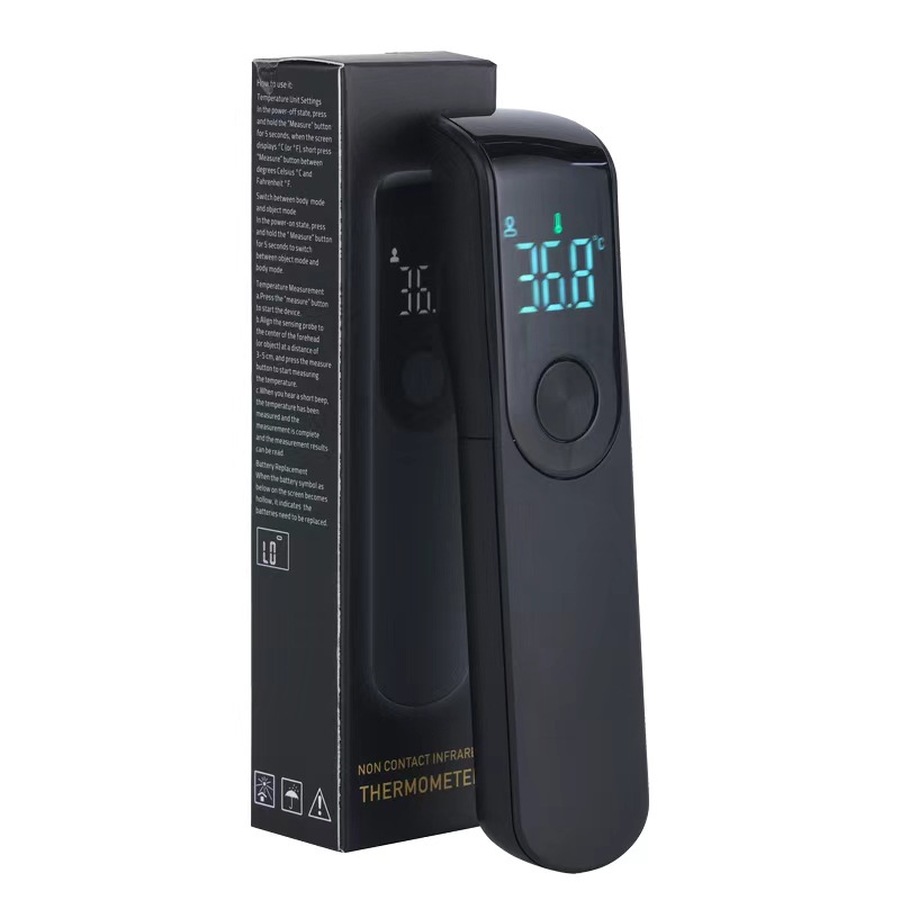
The standard version ships in an English retail color box, 100 pieces per carton. For a distributor, that is a useful starting point: the box is already in the language most export channels expect, and the carton count is high enough to keep handling costs down.
If you need private label, ask three questions before you design anything: what is the MOQ for a custom box, what is the artwork deadline, and who approves the final proof? A low unit price can disappear quickly if the factory requires a separate printing plate, a new manual or a different carton mark. Confirm whether the private-label MOQ is 100, 500 or 1,000 pieces; do not assume it matches the standard MOQ.
For e-commerce fulfillment, check the box size against your warehouse’s prep requirements. A retail box that is not strong enough for direct parcel shipping may need a poly bag or an overbox. That adds cost and changes the dimensional weight. Ask the supplier for a carton drop-test report or a sample carton if you are shipping direct to consumers.
Sample evaluation: a 10-point checklist
Order a small sample before the bulk deposit. Test the unit the way your customer will use it, not only the way the supplier demonstrates it.
- Distance: measure at 1 cm, 3 cm and 5 cm. Check whether the reading is stable and whether the manual explains the correct range.
- Response: time the display from button press to a stable number. Do it ten times and look for outliers.
- Modes: switch between body and object mode. Confirm the icon or display change is obvious.
- Units: switch between °C and °F. Make sure the change survives a battery removal.
- Display: check readability at normal indoor light and at a slight angle.
- Button: press it with a thumb, not a pen. A stiff button is a returns risk.
- Battery: open and close the compartment. Check the spring tension and the polarity markings.
- Box: inspect the print, the model number, the battery statement and the instruction language.
- Carton: confirm the 100-piece count, the gross weight and the carton mark.
- Documentation: match the certificate and manual to the sample’s model and label.
If possible, compare the sample against a calibrated reference in a stable room. Do not use a single reading as proof of accuracy; look at repeatability and the trend across several measurements.
Ten questions to send before the deposit
- What is the exact model number and the sensor type?
- What is the measurement distance, range and resolution?
- Are batteries included, and what type?
- What is the MOQ for the standard box and for private label?
- What is the lead time for 100, 1,000 and 3,000 pieces?
- What is the carton size, gross weight and pieces per carton?
- Which documents can you share for the destination market?
- What is the warranty and the spare-parts policy?
- Can you provide a sample with the final retail box?
- What changes if we add our logo, manual or language sticker?
FAQ
What is the MOQ for this infrared thermometer?
The published MOQ is 100 pieces. Tier pricing starts at 100–999 pieces, 1,000–2,999 pieces and 3,000+ pieces.
Are batteries included?
The standard package list is the thermometer, the English retail box and the certificate. Batteries are not listed, so confirm with the supplier before you print “batteries included” on your listing.
Is this CE or FDA approved?
Do not assume that from the listing. The supplier states Chinese medical device registration and can provide documents; buyers must verify the requirements for their own market and obtain the correct certification or registration before import or sale.
Can I print my own logo on the box?
OEM and private-label packaging are available on request, subject to the supplier’s MOQ and artwork approval. Confirm the private-label MOQ separately from the standard 100-piece MOQ.
How should I calculate freight?
Use the carton data: 100 pieces, 332 × 265 × 138 mm, about 4.4 kg gross weight. Ask for a quote based on actual weight and volume to your destination. Do not use a single flat rate for every market.
Bottom line
For a B2B buyer, the right infrared thermometer is not the one with the lowest headline price. It is the one with a specification you can explain, a carton you can afford to ship, a compliance file you can defend and a MOQ that matches your channel. The OFOSAO mini infrared forehead thermometer is a compact starting point: 100-piece MOQ, three tier prices, English retail box and a 100-piece carton.
Review the OFOSAO mini infrared forehead thermometer product page for the full specification and current tier pricing, or browse the electronics category for related B2B devices.
This article is a sourcing guide, not medical advice or a regulatory approval. Buyers should verify product documentation and destination-market requirements before ordering.